
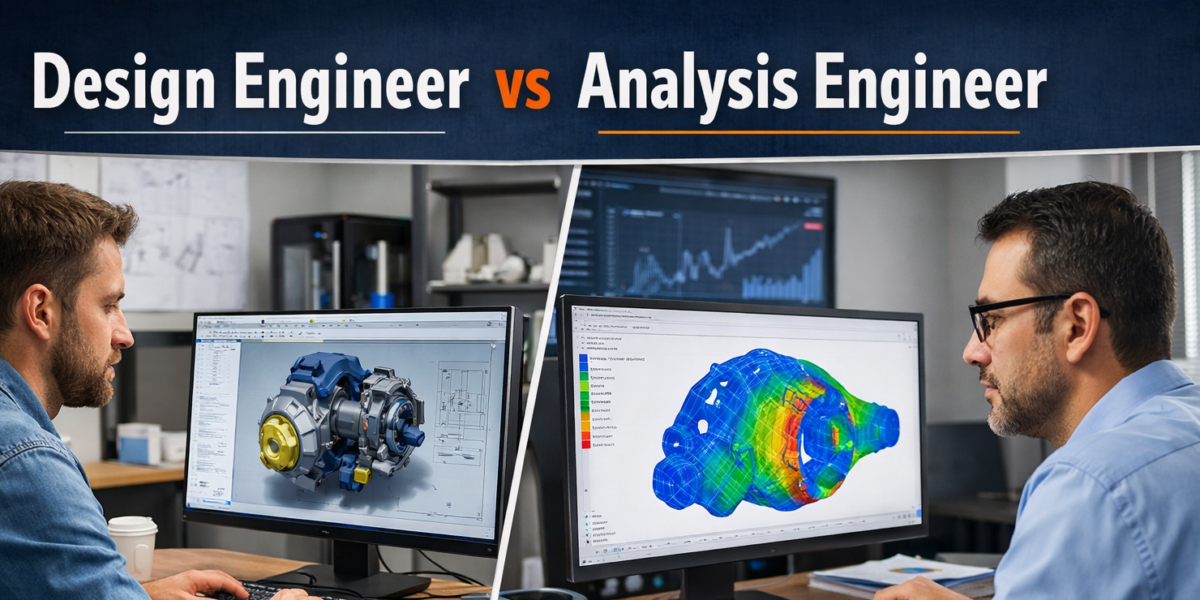
Design Engineer vs Analysis Engineer: Which Career is Better?
Introduction
If you’re an engineering student or a fresh graduate, chances are you’ve asked this question at least once:
Should I become a Design Engineer or an Analysis Engineer?
Both roles are exciting. Both are in demand. And both can lead to strong, high-paying careers in industries like automotive, aerospace, manufacturing, and construction.
But here’s the truth — they are very different in daily work, mindset, and long-term growth.
In this detailed career guide, we’ll break down:
- What a Design Engineer really does
- What an Analysis Engineer actually works on
- Salary comparison
- Skill requirements
- Career growth
- Which personality fits which role
- Real-world example
- FAQs students often ask
By the end of this article, you’ll know exactly which path fits YOU.
What is a Design Engineer?
A Design Engineer is responsible for creating products, components, or systems. They convert ideas into practical designs using CAD software.
In simple words:
A Design Engineer builds the blueprint of a product.
Daily Responsibilities
- Creating 2D drawings and 3D models
- Using CAD tools (SolidWorks, CATIA, Creo, AutoCAD)
- Designing parts based on customer requirements
- Ensuring manufacturability
- Collaborating with production teams
- Modifying designs after testing feedback
Industries Hiring Design Engineers
- Automotive
- Aerospace
- Manufacturing
- Construction
- Consumer product companies
Skills Required
- Strong knowledge of engineering fundamentals
- CAD software expertise
- Creativity and visualization skills
- Understanding of materials and manufacturing
- Attention to detail
What is an Analysis Engineer?
An Analysis Engineer focuses on testing and validating designs using simulations and calculations.
They use CAE (Computer-Aided Engineering) tools to analyze stress, thermal performance, vibration, fatigue, and structural stability.
In simple words:
An Analysis Engineer ensures the design won’t fail.
Daily Responsibilities
- Performing FEA (Finite Element Analysis)
- Running structural, thermal, or fluid simulations
- Using tools like ANSYS, Abaqus, Hypermesh
- Studying stress, strain, deformation
- Preparing validation reports
- Suggesting improvements to design teams
Industries Hiring Analysis Engineers
- Aerospace (very high demand)
- Automotive
- Oil & Gas
- Heavy machinery
- Defense
Skills Required
- Strong mathematics and physics knowledge
- Understanding of mechanics
- Simulation software expertise
- Analytical mindset
- Problem-solving ability
Design Engineer vs Analysis Engineer: Key Differences
Aspect | Design Engineer | Analysis Engineer |
Main Focus | Creating designs | Testing and validating |
Tools | CAD (SolidWorks, CATIA) | CAE (ANSYS, Abaqus) |
Creativity Level | High | Moderate |
Math Intensity | Medium | High |
Client Interaction | More | Less |
Stress Level | Moderate | High (critical validation) |
Salary Comparison
Salary depends on country and industry, but generally:
Entry-Level (India)
- Design Engineer: ₹3–6 LPA
- Analysis Engineer: ₹4–8 LPA
Experienced (5+ Years)
- Design Engineer: ₹8–15 LPA
- Analysis Engineer: ₹10–20 LPA
In aerospace or high-end simulation roles, analysis engineers may earn more due to specialization.
Career Growth Opportunities
Design Engineer Growth Path
- Senior Design Engineer
- Lead Engineer
- Product Development Manager
- R&D Head
- Engineering Manager
Design engineers often move into leadership or product development roles.
Analysis Engineer Growth Path
- Senior FEA Engineer
- Simulation Specialist
- CAE Consultant
- Technical Expert
- Research Scientist
Analysis engineers often grow into niche specialists.
Real-World Example
Let’s imagine a company designing a car suspension system.
Design Engineer
Creates the suspension model using CAD software.
Analysis Engineer
Runs stress and fatigue simulations to ensure it can handle road conditions.
If stress is too high?
The Analysis Engineer sends feedback.
The Design Engineer modifies the model.
This collaboration continues until the product is safe and efficient.
Both roles are equally important.
Which Career is Better for You?
Let’s simplify it.
Choose Design Engineering if:
- You enjoy creativity
- You like visualizing products
- You prefer working on models
- You want leadership growth
- You enjoy practical engineering
Choose Analysis Engineering if:
- You love mathematics and physics
- You enjoy problem-solving deeply
- You prefer technical specialization
- You enjoy simulations and research
- You want high-end technical roles
Work Environment Comparison
Design Engineer
- More team discussions
- More design reviews
- Fast-paced modifications
- Production coordination
Analysis Engineer
- Deep focus work
- Long simulation hours
- High accuracy required
- Less but critical communication
Future Scope (2025 and Beyond)
With AI and automation growing:
- Basic CAD jobs may become automated
- Advanced simulation roles will increase
- Engineers who know both CAD + CAE will dominate
Hybrid engineers (Design + Analysis knowledge) will have the strongest career stability.
Can You Switch Between Roles?
Yes.
Many engineers start as design engineers and later move into analysis.
However, moving from analysis to design is slightly harder unless you maintain CAD practice.
The best approach?
Learn both fundamentals early in your career.
Common Mistakes Students Make
- Choosing based only on salary
- Following friends blindly
- Ignoring personal interest
- Avoiding math but choosing analysis
- Avoiding creativity but choosing design
Career satisfaction matters more than initial salary.
FAQs
Is Analysis Engineer better than Design Engineer?
Not necessarily. It depends on your interest, skillset, and career goals.
Which job is more stressful?
Analysis roles can be more stressful due to critical safety validation.
Which role has better salary growth?
Analysis engineers often have slightly higher salary growth in technical industries.
Can a Design Engineer learn FEA?
Yes. Many professionals upskill in FEA to expand career opportunities.
Which is easier for freshers?
Design engineering is generally easier to enter for beginners.
Which has more job opportunities?
Design roles have wider openings. Analysis roles are more specialized.
Final Verdict: Which Career is Better?
There is no universal “better.”
There is only what fits YOU better.
If you are creative and love building — choose Design Engineering.
If you are analytical and love problem-solving — choose Analysis Engineering.
And if you’re smart?
Learn both.
That combination is powerful.
Conclusion
Choosing between Design Engineer vs Analysis Engineer is one of the most important decisions in an engineering career.
Both roles are essential.
Both offer strong growth.
Both can be financially rewarding.
The key is self-awareness.
Ask yourself:
- Do I enjoy creating?
- Or do I enjoy analyzing?
Your honest answer will guide your career.
