
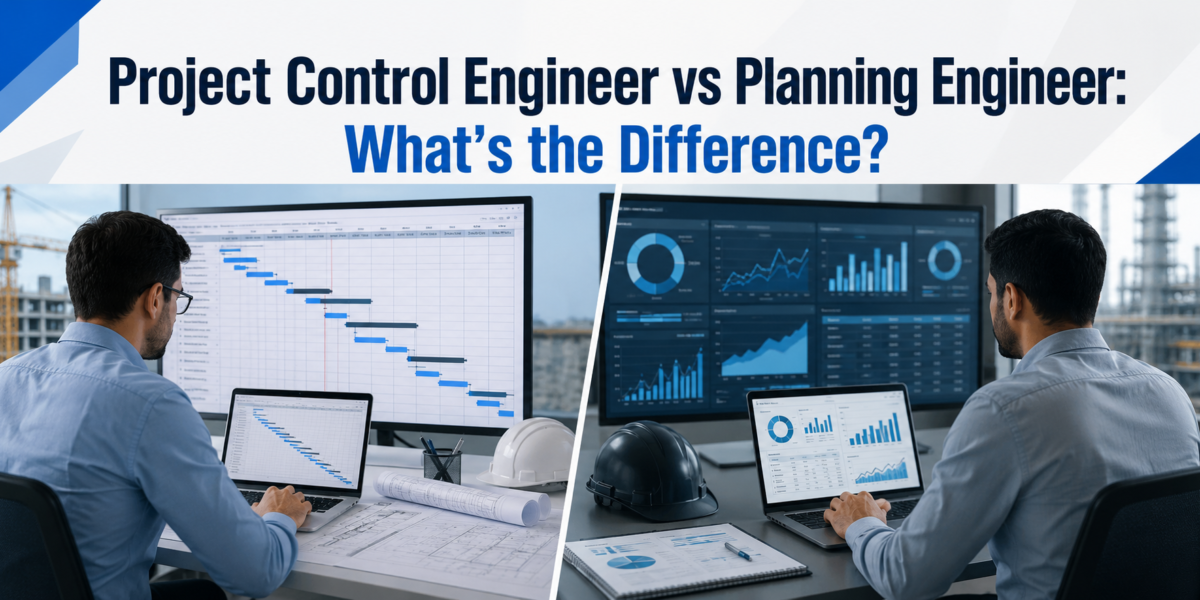
Project Control Engineer vs Planning Engineer: What’s the Difference?
Introduction
The main difference between a Project Control Engineer and a Planning Engineer is that the Planning Engineer is mainly focused on project schedules, timelines, activities and resource planning, whereas the Project Control Engineer is mainly focused on the overall performance of the project which includes schedule, cost, progress, risks and reports. Both positions are critical to construction, oil and gas, infrastructure, manufacturing and engineering projects. The Planning Engineer develops the project plan and the Project Control Engineer maintains project on schedule, on budget and on scope.
Who Is a Planning Engineer?
The project schedule must be created and kept up to date by a planning engineer. This position entails segmenting the project into tasks, allocating time, establishing benchmarks, creating baseline schedules, and monitoring advancement. Planning engineers frequently create comprehensive project timetables using programs like Primavera P6, Microsoft Project, and Excel. Their primary objective is to guarantee that every project activity is appropriately planned and finished within the allotted time frame.
Who Is a Project Control Engineer?
Schedule monitoring, cost control, progress measurement, risk tracking, and performance reporting are all part of the larger responsibilities of a project control engineer. Comparing actual project performance with the intended baseline is the main focus of this position. Project control engineers detect hazards, productivity problems, delays, and cost overruns that could impact project completion. They give management precise reports so they may make better decisions and take remedial action.
Key Difference Between Planning and Project Control
While project control involves keeping an eye on and managing the project once it has started, planning mostly involves creating the project roadmap. While a project control engineer investigates whether the project is proceeding according to schedule, budget, and productivity, a planning engineer creates schedules and reports progress. To put it simply, project control verifies what is actually happening and how to address deviations, whereas planning specifies what should happen and when.
|
Category |
Planning Engineer |
Project Control Engineer |
|
Main Focus |
Schedule planning and timeline management |
Overall project performance control |
|
Core Responsibility |
Preparing and updating project schedules |
Monitoring cost, schedule, progress, and risks |
|
Key Tools |
Primavera P6, MS Project, Excel |
Primavera P6, Excel, Power BI, ERP, Cost Control Tools |
|
Main Output |
Baseline schedule, lookahead plan, progress update |
Cost report, progress report, variance report, dashboard |
|
Work Area |
Planning and scheduling |
Planning, cost control, reporting, and performance analysis |
|
Career Scope |
Scheduling, planning, project coordination |
Project controls, cost control, project management |
Responsibilities of a Planning Engineer
Project schedules, work breakdown structures, resource plans, and progress reports are all created by a planning engineer. To gather activity updates, they collaborate with site teams, engineers, contractors, and project managers. In accordance with the schedule, they also create progress reports on a daily, weekly, and monthly basis. Their work aids in the project team’s comprehension of upcoming tasks, deadlines, and priorities.
Responsibilities of a Project Control Engineer
Project performance is monitored by a project control engineer in relation to the budget and approved plan. They keep an eye on risk factors, earned value, productivity, schedule variance, cost variance, and material status. They create reports and dashboards that indicate whether the project is on schedule, behind schedule, within budget, or over budget. Their role is highly analytical and helps management take corrective actions before problems become serious.
Skills Required for Planning Engineer
Planning engineers need to be well-versed in scheduling techniques, Primavera P6, MS Project, Excel, construction sequences, and resource planning. They also need to know how to create activity relationships, critical paths, milestones, and baseline schedules. Since planning engineers work with multiple teams, they also need to have good communication skills. Finally, a technical understanding of project execution helps them create realistic and practical schedules.
Skills Required for Project Control Engineer
Planning, cost control, data analysis, reporting, risk management, and project performance measurement are all necessary for a project control engineer. It is highly beneficial to have knowledge of earned value management, cost forecasting, dashboards, and variance analysis. They should also be comfortable using Excel, Primavera P6, Power BI, and project management software. This role requires both technical knowledge and strong analytical thinking.
Which Career Is Better?
The ideal option will depend on your interests, however both occupations provide good potential. A career as a planning engineer is a fantastic choice if you appreciate scheduling, activity planning, project timetables, and site coordinating. Project Control Engineer might be a better choice if you’re interested in dashboards, management reporting, performance tracking, cost control, and progress analysis. As they gain expertise, many individuals transition from Planning Engineers to Project Control positions.
Conclusion
Although they work closely together, planning engineers and project control engineers have different responsibilities. A planning engineer primarily develops and updates the project schedule, whereas a project control engineer keeps an eye on all aspects of the project’s performance, including time, cost, progress, and risks. Both positions are crucial for the successful completion of a project, and for new engineers and engineers, mastering Primavera P6, Excel, project scheduling, cost control, and reporting skills can open up strong career opportunities in both fields.
Frequently Asked Questions
What is the difference between a Planning Engineer and a Project Control Engineer?
A Planning Engineer focuses mainly on project schedules and timelines, while a Project Control Engineer monitors schedule, cost, progress, risks, and overall project performance.
Can a Planning Engineer become a Project Control Engineer?
Yes, many Planning Engineers grow into Project Control roles after gaining experience in scheduling, progress tracking, cost control, and reporting.
Which software is important for Planning Engineers?
Primavera P6, MS Project, and Excel are commonly used by Planning Engineers for project scheduling and progress updates.
What skills are needed for Project Control Engineers?
Project Control Engineers need planning, cost control, reporting, data analysis, earned value management, and project monitoring skills.
Which role has better career growth?
Both roles have strong career growth. Planning Engineers can grow into Senior Planner or Planning Manager roles, while Project Control Engineers can grow into Project Controls Manager or Project Manager roles.
