
What Is the Difference Between CAD, CAM, and CAE?
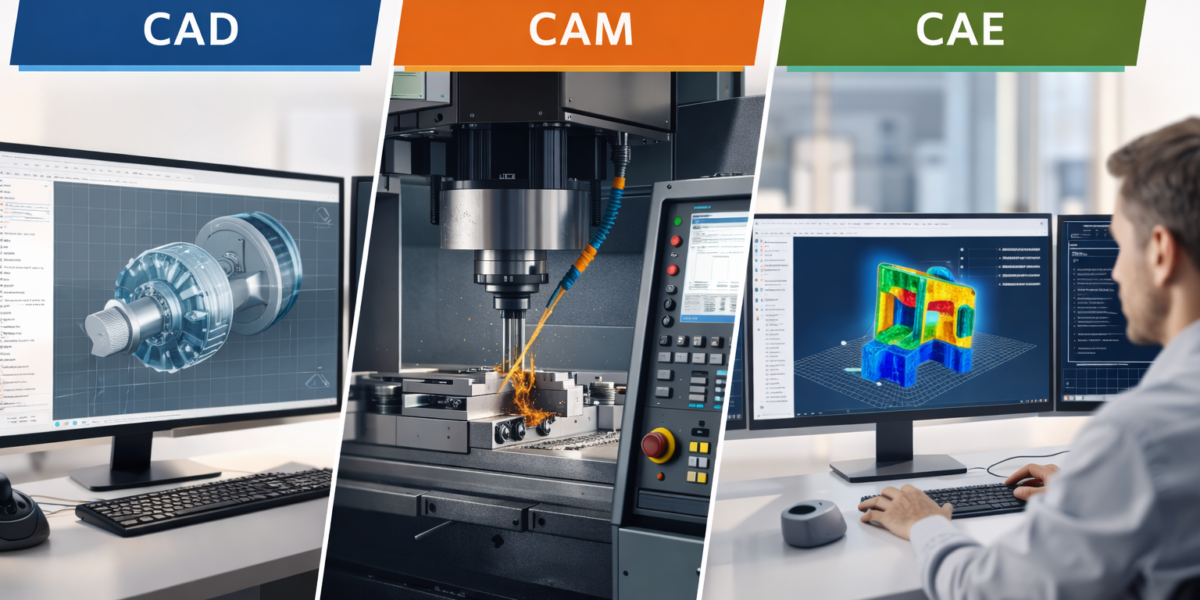
CAD (Computer-Aided Design), CAM (Computer-Aided Manufacturing), and CAE (Computer-Aided Engineering) are three technologies that are frequently used in the design and manufacturing industries. Although they are closely related, each technology has a distinct function in the product development process, and knowing the differences between them helps engineers and businesses streamline design, analysis, and production.
CAD (Computer-Aided Design)
CAD software is used to create intricate digital drawings and product models. CAD tools are used by engineers and designers to create 3D models or 2D drawings with exact measurements and specifications. It facilitates easy alterations without having to start from scratch and helps visualize the product before it is built. Product development, mechanical engineering, automotive design, and architecture are just a few of the fields that make extensive use of CAD.
CAM (Computer-Aided Manufacturing)
CAM focuses on employing computer-controlled machinery to manufacture a product. Following the creation of a design in CAD, CAM software transforms it into instructions that CNC machines and other machines can use to manufacture the product. This technology speeds up manufacturing, lowers human error, and increases production precision. CAM guarantees the effective conversion of the digital design into a tangible product.
CAE (Computer-Aided Engineering)
Before a product is manufactured, its performance is tested through analysis and simulation. CAE software is used by engineers to assess elements including durability, airflow, heat, and stress. CAE assists in the early detection of any design issues by replicating real-world settings. In addition to lowering development costs, this enhances the finished product’s overall dependability and safety.
Key Difference Between CAD, CAM, and CAE
Feature | CAD (Computer-Aided Design) | CAM (Computer-Aided Manufacturing) | CAE (Computer-Aided Engineering) |
Purpose | Used to create and modify product designs digitally. | Used to manufacture products using computer-controlled machines. | Used to analyze and simulate designs to test performance. |
Main Function | Designing 2D drawings and 3D models. | Converting designs into machine instructions for production. | Testing strength, durability, heat, stress, and performance. |
Stage in Product Development | Design stage. | Production or manufacturing stage. | Analysis and testing stage before production. |
Users | Designers, architects, product designers, mechanical engineers. | Manufacturing engineers, CNC operators, production teams. | Engineers, analysts, and simulation specialists. |
Output | Digital drawings or 3D models. | Machine code and instructions for manufacturing. | Simulation results, performance reports, and engineering analysis. |
Example Use | Designing a car part or building model. | Producing the car part using CNC machines. | Testing if the car part can withstand pressure or heat. |
Conclusion
Together, CAD, CAM, and CAE are crucial elements of digital production. CAD develops the design, CAE evaluates its functionality, and CAM uses automated manufacturing to make the design a reality. Businesses can increase overall efficiency in the engineering and manufacturing process, lower development time, and improve product quality by incorporating these technologies.
Frequently Asked Questions (FAQ)
1. What does CAD stand for?
CAD stands for Computer-Aided Design. It is software used to create precise digital drawings and 3D models of products, buildings, or mechanical parts.
2. What is the role of CAM in manufacturing?
CAM stands for Computer-Aided Manufacturing. It uses computer software to control machines and tools during the manufacturing process, helping produce products accurately and efficiently.
3. How does CAE help engineers?
CAE stands for Computer-Aided Engineering. It allows engineers to simulate real-world conditions such as stress, heat, or airflow to test how a design will perform before it is manufactured.
4. Can CAD, CAM, and CAE work together?
Yes, these technologies are often integrated. Designers create models in CAD, engineers test the models using CAE, and manufacturers use CAM to produce the final product.
5. Which industries commonly use CAD, CAM, and CAE?
These tools are widely used in industries such as automotive, aerospace, architecture, manufacturing, product design, and mechanical engineering to improve design accuracy and production efficiency.
