
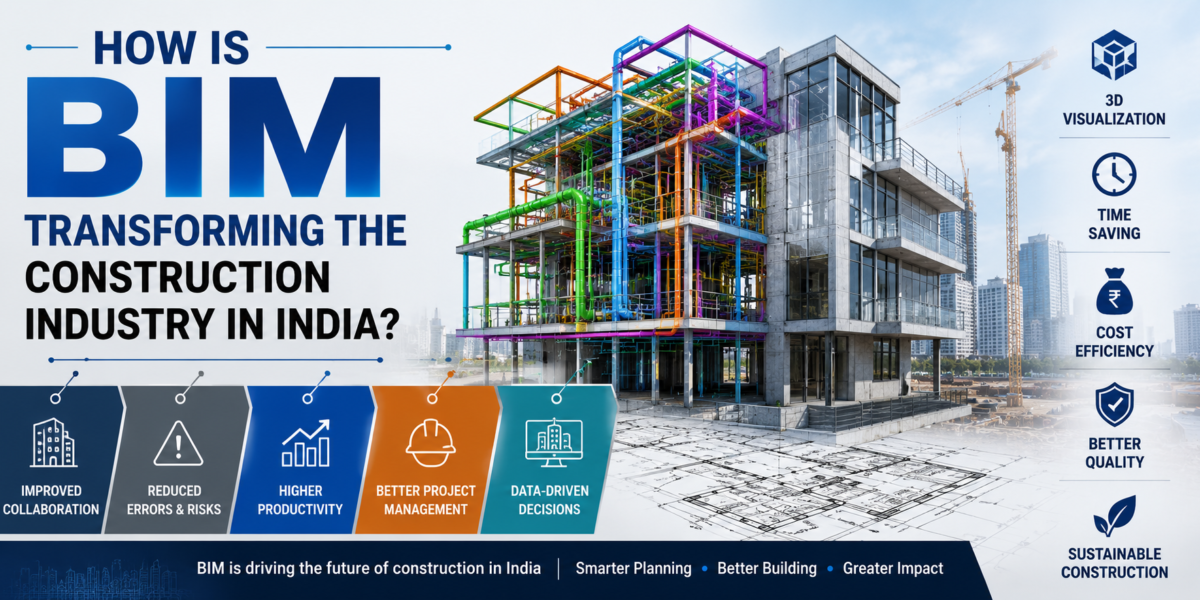
How Is BIM Transforming the Construction Industry in India?
Introduction
The construction industry in India is in a state of rapid evolution with the induction of modern digital technologies and BIM has emerged as one of the most significant innovations in this transformation. BIM is changing the way infrastructure projects are planned, designed, executed and managed across the country. From residential buildings and commercial projects to highways, airports, metros and smart cities, BIM is helping the Indian construction industry to increase efficiency, avoid project delays and improve team collaboration.
Traditional construction methods were often plagued with design errors, communication problems, cost overruns and project delays. These issues are addressed by BIM, which uses intelligent 3D digital models that combine project design, data, scheduling and cost information into a single platform. In this blog, we will see how BIM is revolutionising the construction industry in India and why it is imperative for modern construction projects.
Improving Project Visualization and Planning
One of the major benefits of BIM is better project visualization. BIM allows engineers, architects and clients to see detailed 3D models of buildings and infrastructure projects before they are built.
This enables stakeholders to improve their understanding of layouts, structural elements, and project design. Improved visualization results in better understanding and helps in making faster decisions during project planning phases.
In India, where large-scale infrastructure projects involve multiple stakeholders, BIM improves communication and planning efficiency.
Reducing Design Errors and Rework
Lack of collaboration between architectural, structural and MEP teams can lead to expensive errors in construction projects. 2D traditional drawings sometimes lead to clashes between systems during construction.
BIM helps in early discovery of design conflicts by employing clash detection technology. Engineers can find and fix problems before construction begins, reducing rework, material waste, and delays.
This is very useful in India’s fast growing construction sector where project timelines and budgets matter a lot.
Enhancing Collaboration Between Teams
By enabling several project teams to collaborate on a common digital model, BIM enhances teamwork. Real-time access to updated project information is available to architects, civil engineers, contractors, consultants, and project managers.
This centralized strategy lowers departmental coordination gaps and enhances communication. Teams are able to collaborate more effectively and make adjustments without confusion.
BIM facilitates more efficient project execution and improved teamwork for complex infrastructure projects in India.
Better Cost Estimation and Budget Control
In building projects, cost overruns are a frequent problem. By offering precise quantity take-offs and material estimates straight from the digital model, BIM enhances cost estimation.
Throughout the course of a project, project managers may keep an eye on expenses and make more realistic budget estimates. Additionally, 5D modeling, which integrates cost data with project design and scheduling, is supported by BIM.
Improved budget management helps businesses lower financial risks and increase profitability in India’s cutthroat construction industry.
Improving Construction Scheduling
Through 4D modeling, which connects time-related data with 3D models, BIM facilitates improved project scheduling. Construction teams are better able to track activity timelines and see project progress step-by-step.
This aids in finding delays, streamlining processes, and allocating resources more effectively. On construction sites, improved scheduling lowers project delays and boosts productivity.
Large-scale infrastructure projects in India considerably benefit from better time management made possible by BIM-based planning.
Supporting Smart Cities and Infrastructure Development
India is making significant investments in the development of urban infrastructure, highways, airports, railroads, metro systems, and smart cities. BIM is crucial to the effective management of these intricate projects.
BIM is being used more and more by government organizations and private construction firms to improve project management, sustainability, and digital construction techniques. BIM also enhances lifetime management and long-term infrastructure upkeep.
The use of BIM is anticipated to increase dramatically as India’s infrastructure continues to rise.
Increasing Demand for BIM Professionals
In India, there is a significant need for qualified BIM specialists due to the growth of BIM technology. The construction business today places a high value on BIM-savvy civil engineers, architects, MEP engineers, and project managers.
For current engineering experts, software technologies like Autodesk Revit, Navisworks, Civil 3D, and BIM 360 are increasingly indispensable. Professionals that receive BIM training have better employment prospects and are more competitive in their field.
For infrastructure and building projects, many engineering firms now favor applicants with BIM expertise.
Improving Sustainability and Resource Management
By assisting teams in optimizing resources, cutting waste, and enhancing energy efficiency during project design, BIM also promotes sustainable construction practices.
Before construction starts, engineers can examine the building’s performance, energy use, and environmental impact. This contributes to the development of more environmentally friendly and sustainable infrastructure projects.
In India’s smart city and urban development projects, sustainability is becoming more and more crucial.
Challenges in BIM Adoption in India
Even if the use of BIM is expanding quickly, there are still certain obstacles in India. Software prices, training needs, and deployment procedures might provide challenges for smaller construction firms.
Additionally, industry-wide standardization of BIM procedures and increased awareness are required. But as digital transformation continues, more businesses are spending money on professional training and BIM tools.
BIM is a wise investment for the future since its long-term advantages exceed its initial difficulties.
Conclusion
By enhancing project planning, teamwork, cost control, scheduling, and infrastructure management, BIM is revolutionizing the Indian construction sector. BIM is becoming a crucial technology for contemporary construction methods as the nation continues to create large-scale infrastructure and smart city initiatives.
Learning BIM helps prepare for the future of digital construction and offers substantial employment options for civil engineers, architects, and construction professionals. BIM will continue to have a significant impact on the development of infrastructure and construction in India due to its growing industry acceptance.
FAQs
What is BIM in construction?
BIM stands for Building Information Modeling, a digital process used for designing, planning, and managing construction projects.
How does BIM help the construction industry in India?
BIM improves project visualization, coordination, scheduling, cost control, and collaboration between teams.
Which software is used for BIM?
Popular BIM software includes Revit, Navisworks, Civil 3D, Tekla Structures, and BIM 360.
Is BIM important for civil engineers in India?
Yes, BIM skills are increasingly important because many Indian construction and infrastructure projects now use digital construction technologies.
Does BIM reduce construction costs?
Yes, BIM helps reduce design errors, material wastage, project delays, and rework, which lowers overall construction costs.
