
What Is the Career Scope After Learning CATIA with AI?
Introduction
CATIA (Computer-Aided Three-Dimensional Interactive Application) is one of the leading software used for product design, 3D modeling, and simulation in the engineering and design domain. Its vast functionalities are used in various sectors such as aerospace, automotive, and industrial machinery. However, with the progression of industries, the amalgamation of Artificial Intelligence (AI) with CATIA opens up new avenues and streamlines the entire design and manufacturing process. This blog explores the career opportunities post-learning CATIA with AI and how this combination can set you apart in today’s competitive job market. Its wide range of capabilities is applied in aerospace, automotive, industrial machinery and other industries. But, with the evolution of industries, the integration of Artificial Intelligence (AI) with CATIA offers new opportunities and improves the overall design and manufacturing processes. In this blog, we discuss the career options after learning CATIA with AI and how this combination can give you a competitive edge in the current job market.
What is CATIA with AI?
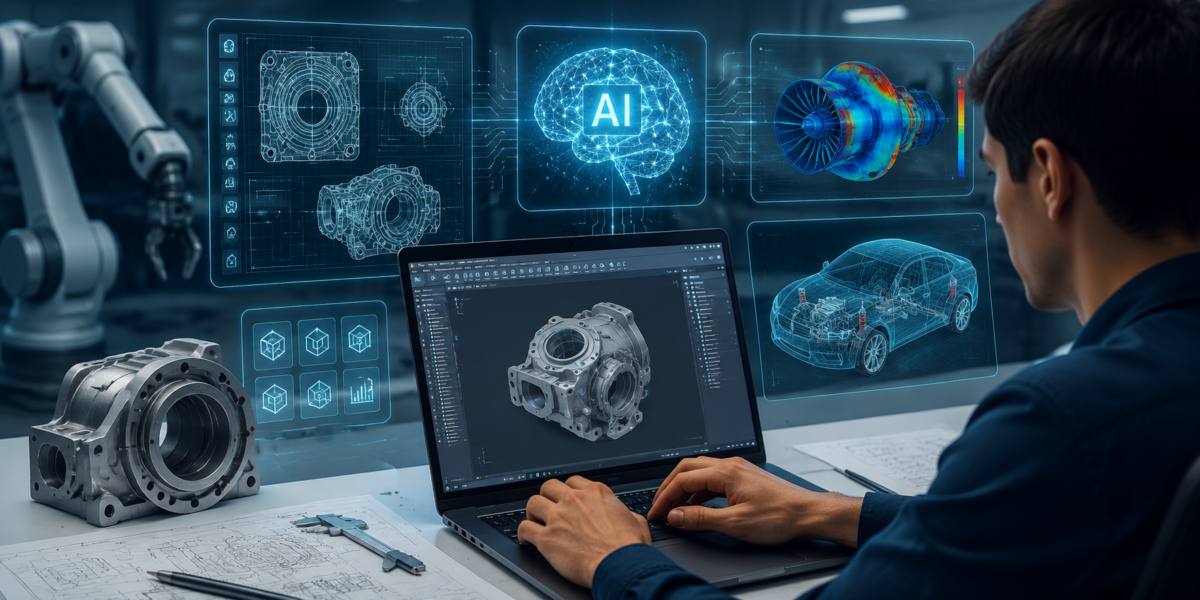
CATIA is a powerful software created by Dassault Systèmes for product design, engineering and manufacturing. It is known for its ability to handle complex and large scale product designs. Embedding AI within CATIA will enable engineers and designers to make the software smarter, more intuitive and efficient in the design process. AI can automate repetitive tasks, predict outcomes and optimize designs, saving time on manual processes and allowing faster product development.
AI can also be employed to analyze vast amounts of design data, offer real-time feedback and suggest design improvements. The inclusion of AI in CATIA makes it an even more powerful tool for industries that need precision and innovation.
Career Opportunities with CATIA and AI Skills
Aerospace Industry:
CATIA is widely used in the aerospace industry to design and simulate complex aircraft and aerospace components. The application of AI in CATIA allows professionals in the aerospace industry to improve design optimization, predictive maintenance, and real-time data analysis. With knowledge of CATIA and AI, you could pursue careers like Design Engineer, Simulation Engineer, or Systems Engineer in aerospace companies. These positions involve expertise in both product design and AI-based analysis to optimize products for performance, safety, and cost-effectiveness. With AI integrated into CATIA, aerospace professionals can take advantage of better design optimization, predictive maintenance and real-time data analysis.
As a CATIA & AI Expert Engineer, you can work as a Design Engineer, Simulation Engineer, or Systems Engineer in aerospace companies. These roles need an in-depth knowledge of product design and AI-based analysis to make sure products are optimized for performance, safety and cost efficiency.
Automotive Industry:
CATIA is used in the automotive industry to design everything from car bodies to engine parts. The integration of AI allows for more intelligent manufacturing processes, predictive modeling, and better analysis of materials and designs. By mastering CATIA with AI, you open up opportunities in automotive design, where you could be an Automotive Design Engineer, Vehicle Systems Engineer, or even an Autonomous Vehicle Designer, especially with the rise of AI-driven vehicles and intelligent car technology. The integration of AI translates into smarter manufacturing processes, predictive modeling and better analysis of materials and designs.
Learning CATIA with AI opens up opportunities in automotive design where you could be working as an Automotive Design Engineer, Vehicle Systems Engineer or even Autonomous Vehicle Designer. Automotive design opportunities are on the rise with the advent of AI-powered vehicles and smart car technology.
Manufacturing and Industrial Engineering:
In manufacturing, CATIA with AI can optimize production lines, reduce waste, and improve manufacturing processes. AI-powered CATIA solutions can automate many tasks involved in product design and manufacturing, improving efficiency and reducing costs. With CATIA and AI expertise, you could pursue roles such as Industrial Design Engineer, Production Planner, or Manufacturing Automation Engineer. These roles would involve working on cutting-edge projects that combine design and AI-driven manufacturing processes to create innovative products.
AI-Driven CATIA solutions can streamline many of the processes in product design and manufacturing, making them more efficient and less costly. Being skilled in CATIA and AI can get you jobs like Industrial Design Engineer, Production Planner, Manufacturing Automation Engineer and so on. These roles would work on cutting-edge projects that blend design and AI-driven manufacturing processes to create breakthrough products.
Product Design and Simulation:
Product design and simulation are critical to industries such as consumer electronics, medical devices and heavy machinery. AI can be used to develop smarter products, predict failures in design, and suggest design changes before physical prototypes are fabricated.
Become a Product Design Engineer, Design Optimization Specialist or CAE (Computer-Aided Engineering) Analyst with expertise in CATIA and AI and get involved in revolutionary product development and smart design techniques.
Research and Development (R&D):
The combination of AI and CATIA also creates new career possibilities in R&D. This is especially true in companies that are dedicated to breaking new ground in design and innovation. AI enables R&D teams to simulate and test designs faster and more efficiently. You can leverage your expertise in AI and CATIA to work as an AI Research Engineer or Simulation Specialist in R&D, contributing to the development of new technologies and solutions across a variety of fields, including robotics, healthcare, and green energy.
Why Should You Learn CATIA with AI?
High Demand Across Multiple Industries:
CATIA + AI is a very desirable combination in industries such as aerospace, automotive, manufacturing and product design. As these sectors become more reliant on AI and automation, professionals with these skills will be in high demand.
Job Security and Carxeer Growth:
As the industry is always growing, CATIA professionals who can leverage the power of AI tools will have job security and lots of career growth opportunities. AI is a new technology, and as companies start to use AI more, the demand for skilled people will keep growing.
Increased Efficiency and Productivity:
Learn CATIA with AI and become skilled at optimizing designs, automating processes, and predicting outcomes using the software. This skill set will make you an asset to any organization, allowing them to reduce development time, reduce cost and improve product quality.
Cutting-Edge Technology:
“AI is one of the most exciting technologies today and its convergence with design tools such as CATIA is transforming how products are designed and manufactured. Learning this combination will allow you to work at the forefront of innovation, using advanced technologies to solve real-world problems.
Conclusion
The combination of CATIA and AI is revolutionizing the way engineers and designers develop products, manufacture and optimize designs. Learning these technologies opens up a myriad of employment opportunities in high demand industries such as aerospace, automotive, manufacturing and product design. As companies seek to design and manufacture products in smarter, faster and more efficient ways, professionals with CATIA and AI skills will be in high demand. If you’re interested in a career in design, simulation, automation, or R&D, this skill set will give you the tools you need to succeed in the fast-changing worlds of technology and engineering.
FAQs
Is CATIA difficult to learn?
CATIA can be complex, but with dedication and the right training, it is definitely manageable. Learning CATIA with AI enhances your ability to work on cutting-edge projects, and the skills you develop are highly valuable.
What is the role of AI in CATIA?
AI helps optimize designs, predict failures, automate repetitive tasks, and improve overall efficiency in the design and manufacturing process.
How can learning CATIA with AI boost my career?
Learning CATIA with AI opens up opportunities in industries like aerospace, automotive, manufacturing, and R&D, where AI-driven design is becoming more critical.
What jobs can I get after learning CATIA with AI?
Some potential roles include Design Engineer, Simulation Specialist, Product Design Engineer, Manufacturing Automation Engineer, and AI Research Engineer.
What are the benefits of AI in design?
AI improves design efficiency, predicts outcomes, identifies potential flaws, and helps with decision-making during the design and manufacturing process, leading to faster and more cost-effective results.
